We’ve been doing some important work behind the scenes at GFXSounds. Over the past weeks, we went back through all of the SFX bundles in our Free Sound Packs library and reworked the audio files one by one.
Instead of simply repackaging the existing downloads, we downloaded the original sounds, reviewed them, cleaned them up, and mastered them again to create a more consistent and professional library.
The result is simple: cleaner sound effects, better technical consistency, and files that are easier to use in professional projects.
Every SFX Pack Is Now 48 kHz / 24-bit
One of the biggest changes is that the sounds across our SFX packs are now maintained at 48 kHz and 24-bit depth.
These numbers can sound complicated, but the basic idea is actually very simple.
What Does 48 kHz Mean?
Think about audio like a very fast camera.
A video camera creates movement by taking lots of pictures every second. Digital audio works in a similar way, except instead of taking pictures, it takes tiny measurements of a sound wave.
48 kHz means the audio system takes 48,000 of these little sound “snapshots” every second.
The more accurately we capture those moments, the more faithfully we can represent the original sound.
48 kHz is also a widely used sample rate for video, film, games, animation, broadcast, and other audiovisual production, which makes it a natural format for a professional sound-effects library.
And What Does 24-bit Mean?
If sample rate tells us how many times we measure the sound, bit depth tells us how much detail we can store in each measurement.
Imagine drawing a picture with crayons.
With only a few colors, you can still create a picture, but some of the little differences between colors will disappear. Give yourself a much bigger box of crayons and you can make smoother, more detailed changes between one color and another.
Audio bit depth works a little like that.
Using 24-bit audio gives us much more precision and dynamic range, making it particularly useful when sounds are going to be edited, processed, layered, mixed, or heavily manipulated.
For sound designers, editors, filmmakers, and game developers, that extra headroom can be very useful.
Every Sound Was Mastered Individually
A sound-effects library can contain recordings with completely different characteristics.
A tiny button click is not the same as an explosion. Footsteps behave differently from ambience. Mechanical sounds have different transients and dynamics than environmental recordings.
Because of this, simply applying one processing setting to an entire collection would not produce the results we wanted.
Instead, the sounds were reviewed and mastered individually, allowing us to preserve their natural dynamics while improving consistency throughout each pack.
True Peak Limiting for Better Peak Control
As part of the mastering process, we also used true peak limiting.
Normal digital meters look at individual audio samples. However, when those samples are reconstructed during playback, the signal between them can sometimes create a peak that is slightly higher than the samples themselves suggest.
These are often called inter-sample peaks.
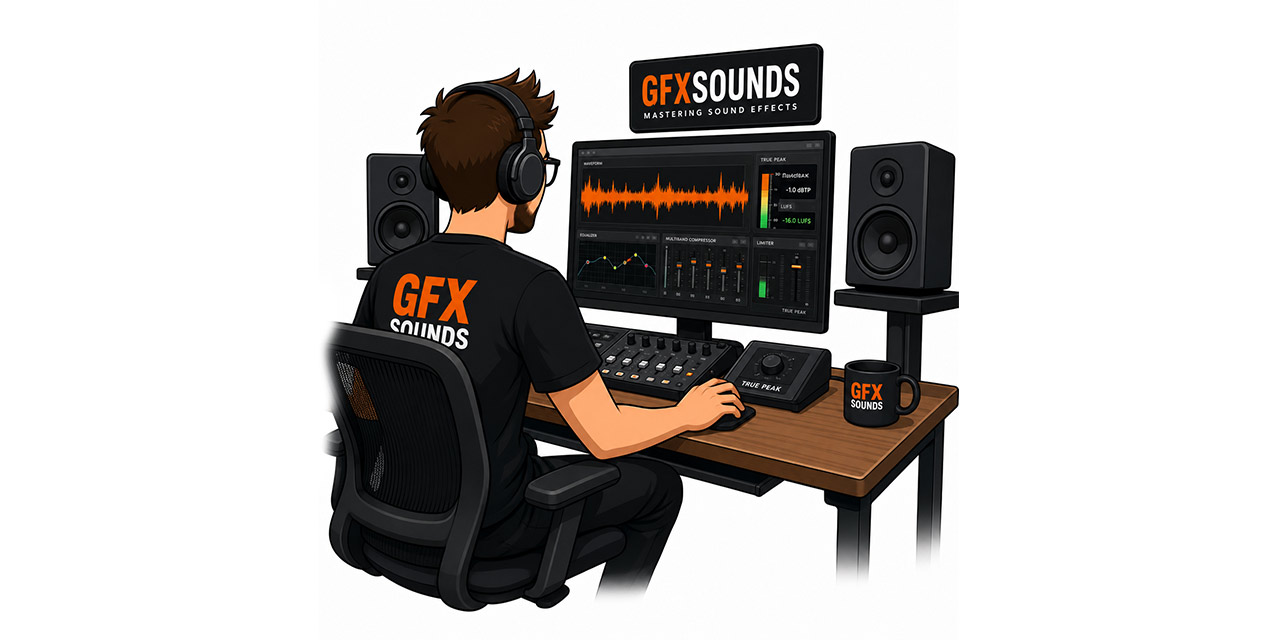
True peak limiting helps us control those peaks more accurately and reduce the risk of unwanted clipping during playback, conversion, encoding, or additional processing.
If you want a simple explanation of how this works, we created a dedicated guide:
Understanding True Peak: A Beginner’s Guide
It explains true peak without requiring an audio-engineering degree.
Why We Made These Changes
Sound effects often go through much more processing after they are downloaded.
You might pitch them down, stretch them, compress them, layer several sounds together, add distortion, process them through reverb, or combine them with dozens of other elements inside a mix.
Starting with a clean, high-quality source makes all of that easier.
By standardizing our SFX packs at 48 kHz / 24-bit, cleaning the source material, mastering the individual sounds, and controlling true peaks, we’re creating a stronger starting point for whatever you want to build with them.
Same GFXSounds Packs, Better Audio
You don’t need to change the way you use GFXSounds.
The difference is inside the files.
Our aim with this update was to improve the technical quality of the library without making things more complicated for the people using it.
Whether you are creating a YouTube video, film, trailer, game, animation, podcast, commercial, or experimental sound-design project, you now have a cleaner and more consistent collection of source material to work with.
You can explore and download the updated packs from our Free Sound Packs section.
And this is only part of our ongoing work to keep improving the GFXSounds library.